

Ice dams are why so many Chippewa Valley roofs leak in winter, and if you've got a ceiling stain spreading in February you're almost certainly looking at one. Here's the part most homeowners miss: the leak isn't really a roofing problem or a gutter problem on its own, it's what happens when a warm attic, a cold eave, and an undersized gutter all line up on the same house. We've scoped these roofs around Eau Claire since 1993, and owner Stephen Bonander has read this exact failure hundreds of times over 33 years. This is how the water actually gets in, and the drainage and ventilation steps that stop it.
How do ice dams form on a Wisconsin roof?
An ice dam forms when heat escaping your attic melts the snow on the upper roof, that meltwater runs down to the cold eave and gutter, and it refreezes there into a ridge of ice. Every melt cycle adds to the dam, and eventually water pools behind it and backs up under the shingles. On a Chippewa Valley home that cycles above and below freezing dozens of times a winter, that dam can rebuild itself for weeks. Three things have to be present:
- Snow on the roof to supply the meltwater, which we get plenty of from December through March.
- A warm upper roof deck, driven by attic heat loss, that melts the snow from below.
- A cold eave and gutter where that meltwater refreezes because it overhangs unheated space.
Take away any one of those and the dam can't build. That's the whole strategy behind prevention, and it's why the fix is almost never "just clean the gutters."
Water damage from gutters in winter: where the leak actually shows up
The gutter itself rarely fails first. What happens is the gutter fills with ice, loses any ability to carry water away, and becomes the anchor point where the dam grows up the roof. Once water backs up past the first course of shingles, it follows the path of least resistance into the house. In the homes we open up around the valley, the damage lands in a predictable order.
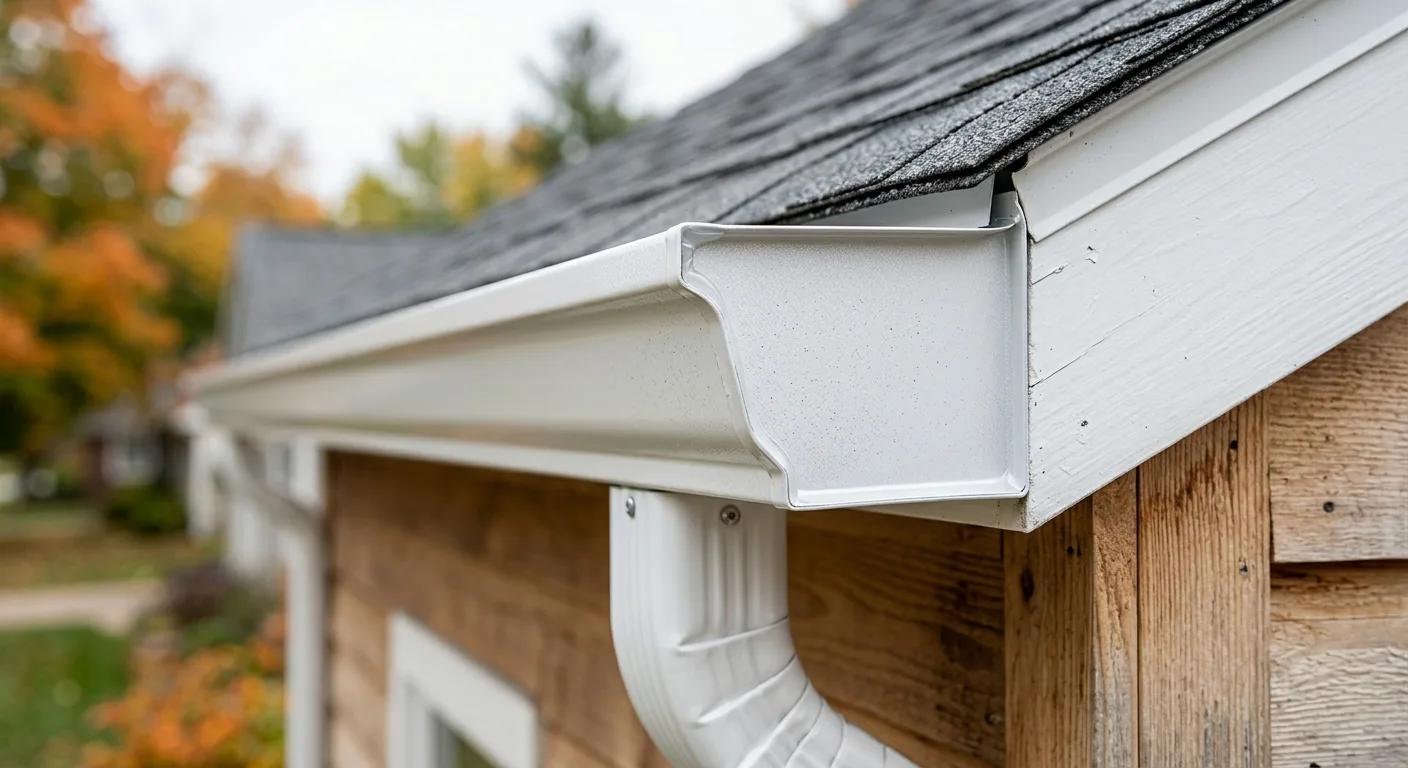
First it wicks into the roof decking and the fascia behind the gutter. Then it tracks down into the exterior wall, soaking insulation and eventually staining interior drywall. By the time you see a brown ring on a bedroom ceiling, the water has usually been moving for days. That lag is why winter roof leaks feel like they appear out of nowhere. If yours has reached the ceiling, our gutter installation and drainage crew and roofing crew work the same call, because the fix touches both.
"Homeowners call us about the gutter, but nine times out of ten the water is coming from a dam that formed because the attic is too warm. Fix the gutter alone and you'll be calling again next winter."
When this is NOT the service you need yet
Straight talk: if your only symptom is a few icicles hanging off the gutter and there's no staining inside, no soaked fascia, and your attic feels genuinely cold, you may not need any work this year. Icicles alone are common on Wisconsin eaves and don't always mean a dam is backing water into the house. Keep an eye on the ceilings, watch for melt-water tracking behind the gutter, and don't let anyone talk you into tearing off a sound roof over a cosmetic icicle. When there's active water intrusion, that's when you call.
Do gutter guards help with ice dams?
Not really, and this is where a lot of homeowners get sold something that doesn't solve the problem. Gutter guards keep leaves and debris out so water flows freely in the warm months, and that's genuinely useful in fall. But a guard does nothing about attic heat loss, and it can't stop water from refreezing on a cold eave. In a hard Chippewa Valley winter, ice will form on top of a guarded gutter just as readily as an open one.
Some homeowners ask about heated gutters and roof de-icing cables as a shortcut. Heated gutter systems and self-regulating cables can help in a targeted trouble spot, a chronically shaded valley or a north-facing eave that never sees sun, but they treat the symptom and run up your electric bill every winter. We'd rather fix the cause. Nine times out of ten the durable answer is up in the attic, not on the gutter.
The real fix: attic ventilation and insulation, then right-sized gutters
Preventing ice dams is a two-part job, and the order matters. First you keep the roof deck cold so the snow doesn't melt from below. Then you make sure the gutter can actually move water off the eave the moment it does thaw. Skip the first part and no gutter on earth keeps up.
Keep the deck cold (this is the part that stops dams):
- Air-seal the attic floor so warm indoor air stops leaking up around light fixtures, bath fans, and the attic hatch. This is the single biggest lever on most valley homes.
- Add insulation to depth. Older Chippewa Valley homes, especially the pre-1970 stock around Eau Claire and Chippewa Falls, were often built with far less attic insulation than a modern winter demands. It's the same housing stock we see behind most winter gutter failures in Chippewa Falls.
- Ventilate soffit to ridge so outside air washes the underside of the deck and carries heat away before it can melt snow. Blocked soffit vents are a common culprit we find.
Then size and pitch the gutters for real snowmelt:
- Right-sized troughs and downspouts that can carry a fast midday thaw instead of overflowing behind the fascia. On steeper or larger roofs we often step up gutter and downspout size for exactly this reason.
- Correct pitch and secure hangers so the gutter drains fully and doesn't sag into a low spot where ice pools.
- Downspouts that discharge well away from the foundation, so the meltwater you do move doesn't refreeze at the base of the house.
That's why we look at the attic and the gutters on the same visit. Our roof ventilation and ice-dam prevention assessment and our seamless gutters in Eau Claire work are two halves of one fix, and pricing every job on-site means you only pay for the parts your house actually needs. If you're weighing a full replacement, request an estimate at our quote page or just call and we'll walk the roof with you.
Frequently asked questions
How do I prevent ice dams on my house?
Prevent them by keeping the roof deck cold and the meltwater moving. That means air-sealing and insulating the attic floor so heat stops escaping, ventilating soffit to ridge so the deck stays cold, and making sure your gutters are sized and pitched to carry a fast thaw off the eave. Roof rakes and calcium-chloride socks are stopgaps during an active winter, but the lasting fix is attic ventilation and drainage. We assess both on one visit and tell you which your house actually needs.
Will cleaning my gutters stop the leak?
Usually not on its own. Clean gutters help water flow in fall, but an ice dam forms from attic heat melting snow that refreezes at the cold eave, and a clean gutter still freezes solid in a Chippewa Valley cold snap. Cleaning is worth doing; expecting it to stop a winter leak is where homeowners get burned.
Is a winter roof leak an emergency?
If water is actively staining or dripping through a ceiling, treat it as one. Water behind a dam soaks decking, insulation, and drywall within a day or two, and mold follows fast in a heated home. Call (715) 894-1120 and we'll get out to stop the source before it spreads.
Stop the water at the source
An ice-dam leak is one of the few home problems that gets measurably worse every day you wait, and it's almost never fixed by the one thing homeowners try first. If you've got a stain spreading, icicles turning into a solid ridge, or you just want to know whether your attic and gutters are set up to make it through a Chippewa Valley winter, we'll come look. Call (715) 894-1120 or request a free estimate, and we'll tell you straight what your roof needs, and what it doesn't.